
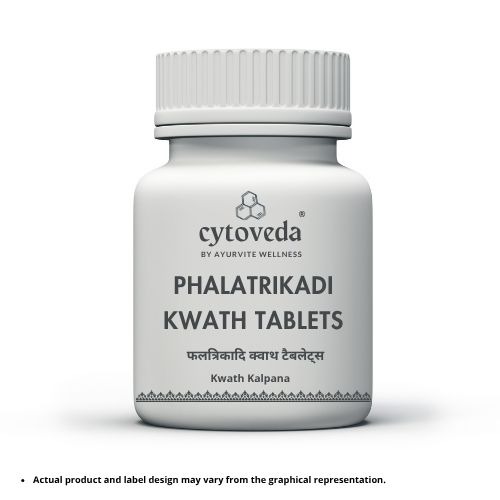
Phalatrikadi Kwath Tablets – Classical Ayurvedic Liver & Pitta Support
Classical Reference: Sharangadhara Samhita, Madhyama Khanda 2/75
Pack: 60 Tablets
Herbal Extract Blend: 500 mg per tablet
Dosage Form: Aqueous herbal extract tablet
What is Phalatrikadi Kwath?
Phalatrikadi Kwath, also written as Phalatrikadi Kwatha or Phalatrikadi Kashaya, is a classical Ayurvedic polyherbal formulation described in traditional Ayurvedic literature.
The word Kwatha refers to a decoction—a pharmaceutical preparation traditionally obtained by boiling specified herbs in water and reducing the liquid to extract water-soluble constituents.
Phalatrikadi Kwatha combines:
- Haritaki
- Vibhitaki
- Amalaki
- Guduchi
- Vasa
- Kutaki
- Chirayata/Kiratatikta
- Nimba
The formulation is particularly associated in classical Ayurvedic literature with Kamala and Pandu and with the correction of disturbed Pitta, Agni and related metabolic functions.
Our tablet presentation uses aqueous extracts of these herbs to provide a convenient dosage form inspired by the classical Kwatha concept without requiring preparation of a fresh decoction every day.
Why Phalatrikadi Kwath is Important in Ayurveda
Ayurveda does not view liver-related disorders only as isolated structural diseases of the liver.
Conditions such as Kamala are understood in relation to several interconnected factors, including:
- Pitta Dosha
- Agni
- Rasa and Rakta Dhatu
- Mala formation and elimination
- Kostha
- Yakrit and Pleeha
- dietary and metabolic disturbances
This is one reason classical formulations often combine herbs having complementary actions rather than relying on a single plant.
Phalatrikadi Kwath combines Tikta, Kashaya, Deepana-Pachana, Pitta-regulating and elimination-supportive herbs in a single formulation.
Classical Ayurvedic Applications
Phalatrikadi Kwatha is classically described in the context of:
Kamala
Kamala is an Ayurvedic clinical condition characterized prominently by yellowish discoloration and Pitta involvement and has clinical similarities with presentations of jaundice.
Pandu
Pandu describes a group of conditions associated with pallor, weakness, altered complexion and impaired nourishment and metabolism.
Because Kamala or jaundice can result from several very different medical conditions—including hepatitis, biliary obstruction, haemolysis, drug-induced liver injury and other serious disorders—jaundice should always be medically evaluated rather than self-treated.
Potential Practitioner-Directed Applications
Based on its classical formulation logic and the traditional actions of its ingredients, an Ayurvedic physician may consider Phalatrikadi Kwath as part of an individualized treatment plan in appropriate cases involving:
- Kamala
- Pandu
- Pitta-dominant hepatobiliary disturbances
- impaired appetite associated with Pitta and Agni disturbance
- Aruchi
- Avipaka
- digestive-metabolic sluggishness
- convalescent weakness associated with digestive and hepatic dysfunction
- selected chronic liver-health presentations
- support during physician-supervised hepatoprotective regimens
The exact indication, dose, Anupana, duration and accompanying medicines should be individualized according to the patient’s Prakriti, Vikriti, Agni, Kostha, Bala, disease stage and concurrent treatment.
Composition
Each tablet provides an equal-proportion aqueous extract blend of:
| Ayurvedic Ingredient | Botanical Identity | Quantity |
|---|---|---|
| Vasa | Adhatoda vasica | 62.5 mg |
| Guduchi / Amrita | Tinospora cordifolia | 62.5 mg |
| Haritaki | Terminalia chebula | 62.5 mg |
| Vibhitaki / Bibhitaki | Terminalia bellirica | 62.5 mg |
| Amalaki | Phyllanthus emblica / Emblica officinalis | 62.5 mg |
| Kutaki | Picrorhiza kurroa | 62.5 mg |
| Chirayata / Kiratatikta | Swertia chirayita | 62.5 mg |
| Neem / Nimba | Azadirachta indica | 62.5 mg |
Total herbal extract blend: 500 mg
Excipients: As required for tablet manufacture.
Understanding the Eight Herbs
1. Kutaki – A Classical Bitter Herb for Pitta and Yakrit
Kutaki (Picrorhiza kurroa) is one of the most important bitter herbs used in traditional Ayurvedic practice when Pitta, digestion and hepatobiliary function are involved.
Its intensely bitter phytochemical profile includes iridoid glycosides such as picrosides.
Modern experimental and clinical literature has investigated Kutaki for:
- hepatoprotective activity
- antioxidant activity
- inflammatory pathways
- bile and digestive physiology
- metabolic health
An older randomized placebo-controlled clinical study also investigated Picrorhiza kurroa root powder in patients with acute viral hepatitis. This research concerns Kutaki as an individual herb and should not be interpreted as proving the efficacy of the present tablet for hepatitis.
2. Guduchi – Amrita of Ayurveda
Guduchi (Tinospora cordifolia) is one of Ayurveda’s best-known Rasayana and Tikta Dravyas.
Traditionally, Guduchi is used in clinical contexts involving:
- Jwara
- Pitta disorders
- inflammatory conditions
- altered metabolism
- convalescence
- immune and systemic resilience
Modern research has examined Guduchi for immunomodulatory, antioxidant, anti-inflammatory and hepatoprotective mechanisms.
Its phytochemistry includes alkaloids, diterpenoids, glycosides, phenolics and polysaccharides.
Importantly, research on Guduchi remains an evolving field. Reports of suspected herb-associated liver injury have also appeared in modern literature, making correct botanical identity, product quality, dose and physician supervision particularly important in patients who already have liver disease.
3. Amalaki – Pitta-Supportive Rasayana
Amalaki (Phyllanthus emblica), or Indian gooseberry, is among the most extensively used fruits in Ayurveda.
It is traditionally considered:
- Rasayana
- Pitta-supportive
- nourishing without being excessively heating
- supportive of digestion and tissue health
Modern phytochemical research has demonstrated that Amalaki contains numerous:
- tannins
- phenolic compounds
- flavonoids
- organic acids
- other antioxidant constituents
Experimental and clinical literature has explored Amalaki in relation to oxidative stress, inflammation, metabolic health, lipid metabolism and hepatoprotection.
4. Haritaki – Supporting Agni and Anulomana
Haritaki (Terminalia chebula) occupies a central place in Ayurvedic therapeutics.
It is traditionally used for supporting:
- digestion
- bowel regulation
- Anulomana
- Agni
- metabolic clearance
Haritaki contains important polyphenolic constituents such as chebulagic acid, chebulinic acid and gallic acid derivatives.
Modern laboratory research has investigated its antioxidant, anti-inflammatory, gastrointestinal and hepatoprotective properties.
5. Vibhitaki – The Second Fruit of Triphala
Vibhitaki (Terminalia bellirica) is traditionally associated with Kapha regulation and forms one-third of the classical combination Triphala.
Research on Terminalia bellirica has identified a variety of phenolic and other bioactive constituents and has investigated antioxidant, metabolic and inflammatory pathways.
In Phalatrikadi Kwath, Vibhitaki complements Haritaki and Amalaki to provide the complete Triphala component of the formulation.
Triphala Within Phalatrikadi Kwath
The combination of:
Haritaki + Vibhitaki + Amalaki
forms Triphala, one of Ayurveda’s most extensively used classical combinations.
Triphala is not merely included as a bowel formulation. Ayurvedic practice employs it more broadly for regulation of digestion, elimination, metabolism and tissue homeostasis.
Modern clinical research on Triphala has examined parameters including:
- lipid profile
- glucose metabolism
- body weight
- gastrointestinal function
- oxidative stress
These studies concern Triphala itself and do not establish identical effects for Phalatrikadi Kwath, but they help explain why this three-fruit combination continues to attract scientific interest.
6. Chirayata – The Classical Bitter Kiratatikta
Chirayata (Swertia chirayita), traditionally known as Kiratatikta, is intensely bitter and has long been used in Ayurveda in conditions involving:
- Jwara
- Pitta
- Aruchi
- impaired digestion
- metabolic disturbances
Research has identified several classes of phytoconstituents in Swertia chirayita and investigated antioxidant, anti-inflammatory, metabolic and hepatoprotective activities.
7. Nimba – Classical Tikta-Kashaya Support
Neem or Nimba (Azadirachta indica) is a major Tikta-Kashaya Dravya of Ayurveda.
Its traditional applications span Pitta-Kapha disorders, skin and metabolic conditions.
Modern research has explored neem-derived compounds such as nimbolide and related limonoids for antioxidant, inflammatory, immunological and cellular signalling effects.
8. Vasa – More Than a Respiratory Herb
Vasa (Justicia adhatoda / Adhatoda vasica) is widely known for its classical role in respiratory medicine, but its traditional pharmacological profile is broader.
Vasa contains quinazoline alkaloids, including compounds related to vasicine, and modern research has investigated antioxidant, anti-inflammatory and hepatoprotective activities in addition to its better-known respiratory actions.
Its inclusion demonstrates the multi-dimensional nature of the classical Phalatrikadi combination.
Why Combine These Herbs?
Phalatrikadi Kwath is a good example of the polyherbal logic of Ayurvedic formulation design.
Rather than using one “liver herb”, the formulation brings together herbs with overlapping but different traditional roles:
Kutaki + Chirayata + Neem
→ strong Tikta-oriented component
Haritaki + Vibhitaki + Amalaki
→ Triphala component supporting digestion, elimination and metabolic regulation
Guduchi
→ Rasayana, Pitta and systemic support
Vasa
→ complements the Pitta and Rakta-oriented formulation profile
This combination creates a broader therapeutic strategy than simply supplying one botanical extract.
Traditional Kwatha vs Phalatrikadi Kwath Tablets
Traditionally, a Kwatha is freshly prepared by boiling coarse herbal material in water and reducing the liquid according to Ayurvedic pharmaceutical principles.
However, traditional Kwatha preparation may be inconvenient for patients because it requires:
- daily preparation
- correct quantity of herbs
- measured water
- controlled boiling
- filtration
- consistent preparation practices
Phalatrikadi Kwath Tablets use aqueous herbal extracts in a convenient tablet format, making the classical formulation concept easier to incorporate into contemporary clinical practice.
A tablet should not automatically be assumed to be pharmacologically identical to freshly prepared Kwatha; extraction ratio, raw-drug quality, manufacturing process and standardization influence the final phytochemical profile.
What Does Modern Research Say About Phalatrikadi Kwatha?
Scientific investigation of Phalatrikadi Kwatha is still limited compared with modern pharmaceutical drugs, but several areas have been studied.
Pharmacognostic and Phytochemical Standardization
A published pharmacognostic study from researchers at Banaras Hindu University evaluated a Phalatrikadi Kvatha variant using:
- physicochemical parameters
- extractive values
- phytochemical screening
- thin-layer chromatography
The investigators reported the presence of phytochemical classes including:
- flavonoids
- tannins
- saponins
- steroids
This work was directed primarily toward identity, purity and quality-control parameters, rather than proving clinical efficacy.
The specific Phalatrikadi formulation studied in that paper was not identical in every ingredient and ratio to all classical versions, illustrating an important point: Phalatrikadi formulations differ between textual traditions and manufacturers.
Clinical Study in Kamala
A 2019 comparative clinical study evaluated Phalatrikadi Kwatha versus Darvyadi Kwatha in patients diagnosed with Kamala.
The trial included 40 patients, with 20 patients in each group, treated for 15 days.
Both groups showed statistically significant changes in the outcomes studied, although the Darvyadi Kwatha group performed better in the authors’ comparison.
This was a small Ayurvedic clinical study and should be regarded as preliminary evidence, not definitive proof of efficacy for every Phalatrikadi product or for every cause of jaundice.
Recent Research on Phalatrikadi Kwath Vati
A 2026 clinical publication has also investigated Phalatrikadi Kwath Vati in comparison with Hapushadi Churna in Kamala.
The indexed abstract confirms that Phalatrikadi Kwath Vati was evaluated clinically, although conclusions about efficacy should be based on assessment of the complete methods and results rather than the abstract alone.
Research on Important Ingredients
Scientific literature on individual ingredients is considerably larger than research on the complete formulation.
Researchers have investigated:
Kutaki
Picrosides, hepatoprotective mechanisms, oxidative stress and inflammatory pathways.
Guduchi
Immunomodulation, oxidative stress, inflammation and experimental hepatoprotection.
Amalaki
Polyphenols, antioxidant activity, metabolic effects and hepatoprotective mechanisms.
Haritaki
Chebulagic acid, chebulinic acid, antioxidant and inflammatory pathways.
Vibhitaki
Antioxidant, metabolic and anti-inflammatory properties.
Chirayata
Bitter phytochemicals, antioxidant and hepatometabolic research.
Neem
Limonoids and other compounds involved in oxidative, inflammatory and immunological signalling.
Vasa
Vasicine-related alkaloids and respiratory, antioxidant and inflammatory pharmacology.
These ingredient-level studies provide biological plausibility and research context, but they cannot by themselves prove that a multi-herb finished product will produce the same effects in humans.
Phalatrikadi Kwath and Liver Health – An Important Distinction
Searching the internet for “Ayurvedic liver medicine” can create the impression that every liver condition can be managed in the same way. This is incorrect.
Abnormal liver function tests or jaundice may arise from:
- viral hepatitis
- alcohol-associated liver disease
- metabolic dysfunction-associated steatotic liver disease
- drug-induced liver injury
- gallstones or biliary obstruction
- autoimmune liver disease
- haemolysis
- pancreatic or biliary disease
- other systemic illnesses
Therefore, Phalatrikadi Kwath should not be used to delay investigation of jaundice, markedly elevated liver enzymes, abdominal pain, persistent vomiting, dark urine or unexplained weight loss.
Ayurvedic treatment is most rational when the underlying diagnosis and the patient’s Ayurvedic clinical assessment are both understood.
Who May Be Considered for Phalatrikadi Kwath?
An Ayurvedic physician may consider this formulation in appropriately selected patients where classical features corresponding to Kamala, Pandu, Pitta disturbance, Aruchi or impaired Agni are present.
Selection should depend on the complete clinical picture rather than solely on a laboratory report.
How to Take Phalatrikadi Kwath Tablets
Dose: As directed by the Ayurvedic physician.
The appropriate dose and duration depend on:
- age
- Agni
- Kostha
- Bala
- clinical diagnosis
- disease stage
- concurrent medicines
- liver and kidney function
- accompanying Ayurvedic therapy
Do not increase the dose merely because the preparation is herbal.
Can Phalatrikadi Kwath Be Taken With Modern Medicines?
Patients already receiving medicines for:
- liver disease
- diabetes
- hypertension
- anticoagulation
- autoimmune disease
- cancer
- transplantation
- other chronic illnesses
should inform their treating physician before adding herbal formulations.
Herbal medicines contain pharmacologically active constituents and should not automatically be assumed to be interaction-free.
Important Safety Information
Use under professional guidance, particularly in:
- diagnosed liver disease
- active jaundice
- pregnancy
- lactation
- children
- patients taking multiple medicines
- patients undergoing chemotherapy or other intensive medical treatment
- patients with autoimmune disease
- patients with unexplained abnormal liver-function tests
Seek medical evaluation urgently for severe jaundice, confusion, bleeding, persistent vomiting, marked abdominal swelling, very dark urine with pale stools or other significant symptoms.
Frequently Asked Questions
What is Phalatrikadi Kwath used for in Ayurveda?
Phalatrikadi Kwatha is classically described particularly in relation to Kamala and Pandu. Ayurvedic physicians may also consider its Pitta, Agni and hepatobiliary-oriented formulation profile when planning individualized treatment.
Is Phalatrikadi Kwath a liver medicine?
It is a classical Ayurvedic formulation strongly associated with Kamala and hepatobiliary-oriented clinical practice. However, “liver disease” includes many different diagnoses, and the formulation should not be regarded as a universal treatment for every liver disorder.
Is Phalatrikadi Kwath useful in jaundice?
Kamala, which has clinical similarities with jaundice, is a classical indication of Phalatrikadi Kwatha. Modern jaundice nevertheless requires diagnosis because obstruction, infection, haemolysis, drugs and several serious diseases can cause it.
What herbs are present in Phalatrikadi Kwath Tablets?
The formulation contains aqueous extracts of Vasa, Guduchi, Haritaki, Vibhitaki, Amalaki, Kutaki, Chirayata and Neem.
Does Phalatrikadi Kwath contain Triphala?
Yes. Haritaki, Vibhitaki and Amalaki together constitute Triphala, which forms an important component of this formulation.
What is the role of Kutaki in Phalatrikadi Kwath?
Kutaki is a strongly bitter Ayurvedic herb traditionally associated with Pitta, digestion and hepatobiliary function. Its iridoid glycosides, including picrosides, have also been investigated in modern pharmacological research.
What is the difference between Phalatrikadi Kwath and Phalatrikadi Kwath Tablets?
Traditional Kwatha is prepared as a decoction. Phalatrikadi Kwath Tablets use aqueous herbal extracts to provide the classical combination in a more convenient solid dosage form. The two dosage forms should not automatically be assumed to have identical extract concentrations unless specifically standardized to demonstrate equivalence.
Can healthy people take it as a daily liver detox?
Routine “liver detox” is not a classical indication that should be applied indiscriminately. Phalatrikadi Kwath is better used according to Ayurvedic assessment and a defined therapeutic objective.
Can Phalatrikadi Kwath be taken for fatty liver?
Some ingredients, particularly Kutaki, Guduchi, Triphala constituents and Amalaki, have been investigated in relation to hepatic and metabolic physiology. However, fatty liver disease requires assessment of body weight, diabetes, lipids, alcohol intake, medications and fibrosis risk. The formulation should therefore be used as part of an individualized management plan rather than as a stand-alone cure.
Can it be taken for elevated SGOT or SGPT?
Elevated AST/SGOT and ALT/SGPT are laboratory findings, not diagnoses. The cause should first be established. An Ayurvedic physician may then decide whether Phalatrikadi Kwath is appropriate in that clinical context.
How long should Phalatrikadi Kwath Tablets be taken?
There is no single duration suitable for every patient. Duration should be determined by the indication, clinical response, laboratory findings where relevant and physician assessment.
Research References for Further Reading
- Sharangadhara Samhita – Madhyama Khanda 2/75 – Classical reference for Phalatrikadi Kwatha.
- Kumar N, Ghildiyal S. Pharmacognostical Standardization of Ayurvedic Hepatoprotective Drug Phalatrikadi Kvatha. International Journal of Pharmaceutical Sciences and Research. 2014.
- Kallanagouda HA, Sarvi SC. A Comparative Clinical Study on Phalatrikadi Kwata and Darvyadi Kwatha in the Management of Kamala with special reference to Jaundice. Journal of Ayurveda and Integrated Medical Sciences. 2019;4(4):138–145. DOI: 10.21760/jaims.v4i04.656.
- Prajapati G, Vyas OP. A Clinical Study of Hapushadi Churna and Phalatrikadi Kwath Vati in the Management of Kamala with special reference to Jaundice. AYUSHDHARA. 2026;13(4):156–168. DOI: 10.47070/ayushdhara.v13i4.2941.
- Review literature on Picrorhiza kurroa has examined picrosides and experimental/clinical hepatoprotective activity.
- Contemporary reviews of Tinospora cordifolia discuss its phytochemistry, immunomodulatory and hepatoprotective research as well as remaining safety questions.
- Systematic and pharmacological reviews of Triphala, Terminalia chebula, Terminalia bellirica and Phyllanthus emblica describe antioxidant, metabolic and inflammatory research relevant to understanding the constituent herbs.
Evidence Note
Traditional Ayurvedic indications, experimental pharmacology, studies of individual ingredients and studies of other Phalatrikadi preparations are different levels of evidence.
Research cited on this page should therefore be interpreted as educational background and scientific context, not as proof that this exact commercial tablet prevents, cures or reverses a specific medical disease.
Reviews
There are no reviews yet.