
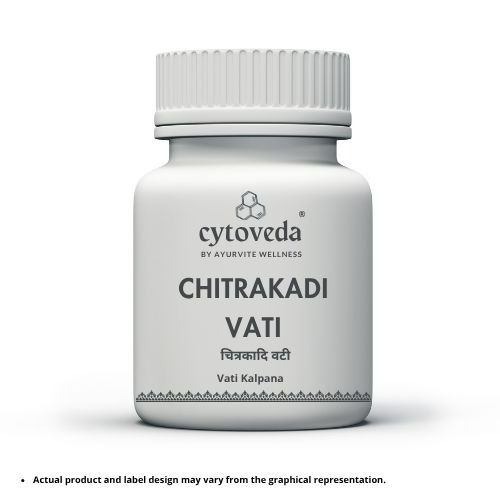
Chitrakadi Vati 250 mg – Classical Ayurvedic Deepana-Pachana Digestive Formula
Reference: Ayurvedic Formulary of India (AFI), Part I – Chitrakadi Gutika
Strength: 250 mg per tablet
Pack: 60 Tablets
Dosage Form: Vati / Gutika
What is Chitrakadi Vati?
Chitrakadi Vati, also known as Chitrakadi Gutika, is a classical Ayurvedic formulation centred around the therapeutic concepts of:
- Deepana – stimulation of digestive capacity
- Pachana – digestion of Ama
- Agnivardhana – enhancement of weakened digestive fire
- Vatanulomana – supporting normal downward movement of Vata
- relief of digestive heaviness, distension and impaired assimilation
Unlike a simple digestive supplement, Chitrakadi Vati is a strong classical formulation intended for situations where Mandagni and Ama form an important part of the Ayurvedic pathogenesis.
It is therefore best understood not merely as an “appetite tablet”, but as an Ayurvedic formulation directed toward restoring the functional efficiency of Agni and Grahani.
Classical Ayurvedic Indications
The Government of India Essential Drugs List identifies the principal indications of Chitrakadi Gutika as:
Agnimandya
Weak or diminished digestive fire, often presenting with:
- poor appetite
- delayed digestion
- heaviness after food
- abdominal fullness
- reduced enthusiasm for food
- sluggish gastrointestinal function
Amadosha
A condition in which incompletely digested or metabolised material—Ama—is considered to contribute to systemic and gastrointestinal disturbance.
Typical Ayurvedic features associated with Ama may include:
- heaviness
- coated tongue
- loss of appetite
- abdominal discomfort
- sticky or improperly formed stool
- lethargy
- altered taste
- sluggish digestion
Grahaniroga
Grahani represents a group of digestive disorders associated fundamentally with impaired Agni and abnormal retention, digestion and passage of food.
Depending on the Dosha and disease stage, Grahani may manifest with:
- irregular bowel habit
- improperly formed stool
- alternating stool consistency
- bloating
- abdominal discomfort
- impaired appetite
- incomplete digestion
- weakness following chronic digestive disturbance
Why Agni is Central to Chitrakadi Vati
Ayurveda considers Agni fundamental to digestion, metabolism, assimilation and tissue nourishment.
When Agni is functioning appropriately:
- food is digested efficiently,
- nutrients become available for tissue formation,
- Mala is appropriately produced and eliminated,
- appetite follows a physiological rhythm,
- heaviness after food is minimized.
When Agni becomes weak—Mandagni—Ayurveda describes a tendency toward:
Mandagni → incomplete digestion → Ama formation → gastrointestinal dysfunction → disturbed Grahani function
Chitrakadi Vati is formulated precisely around this therapeutic sequence.
Its ingredients are predominantly Ushna, Tikshna, Katu, Deepana and Pachana in character, making the formulation especially suited to appropriately selected Mandagni and Ama presentations.
Classical Composition of Chitrakadi Vati
The AFI formulation traditionally contains equal proportions of the following principal ingredients:
Chitraka
Plumbago zeylanica – Root
Pippalimula
Piper longum – Root
Yavakshara
Alkaline preparation derived traditionally from Yava.
Sarjikshara
Classical alkaline ingredient.
Pancha Lavana
The five classical salts used in the formulation include varieties such as:
- Saindhava Lavana
- Sauvarchala Lavana
- Vida Lavana
- Samudra Lavana
- Audbhida/Romaka Lavana
Trikatu
The classical combination of:
- Shunthi
- Maricha
- Pippali
Hingu
Asafoetida
Ajamoda
Chavya
The formulation is traditionally processed with Matulunga or related citrus juice, or Dadima Rasa, according to the classical pharmaceutical method.
Understanding the Formulation Ingredient by Ingredient
1. Chitraka – The Lead Deepana Herb
Chitraka (Plumbago zeylanica) gives the formulation its name.
It is one of Ayurveda’s important Deepana-Pachana herbs and is traditionally used where:
- Agni is weak,
- Ama is present,
- digestion is sluggish,
- appetite is poor,
- Kapha-related digestive heaviness predominates.
Chitraka is considered strongly Ushna and Tikshna, which explains both its therapeutic value and the need for appropriate patient selection.
Modern phytochemical research on Plumbago zeylanica has identified constituents such as plumbagin, although pharmacological findings on isolated compounds should not be equated with the clinical effect of the classical formulation.
2. Pippalimula – Supporting Agni and Vata Regulation
Pippalimula, the root of Piper longum, is traditionally used in digestive formulations for:
- Deepana
- Pachana
- Vatanulomana
- abdominal discomfort associated with impaired digestion
Its warming nature complements Chitraka while contributing to the formulation’s overall Agni-enhancing profile.
3. Trikatu – Shunthi, Maricha and Pippali
A major component of Chitrakadi Vati is Trikatu, consisting of:
Shunthi + Maricha + Pippali
Trikatu is one of Ayurveda’s best-known combinations for stimulating digestive and metabolic function.
Traditionally it is used for:
- Mandagni
- Ama
- Kapha excess
- Aruchi
- impaired digestion
- sluggish metabolism
Modern research has investigated compounds such as:
- gingerols and shogaols from ginger,
- piperine from black pepper,
- piperine and related constituents from long pepper.
Of particular scientific interest, piperine has been studied for its influence on intestinal absorption and drug metabolism. This is also one reason patients taking prescription medicines should not assume that strong herbal digestive formulations are automatically interaction-free.
4. Hingu – Classical Support for Adhmana and Vata
Hingu, or asafoetida, is widely used in Ayurvedic gastrointestinal practice.
It is particularly relevant when impaired digestion is accompanied by:
- abdominal distension
- gas
- colicky discomfort
- Vata obstruction
- heaviness after food
Its inclusion gives Chitrakadi Vati a strong Deepana, Pachana and Vatanulomana orientation.
5. Ajamoda
Ajamoda is traditionally used for:
- appetite support
- digestive stimulation
- abdominal gas
- Vata-Kapha digestive disturbances
It complements Hingu, Trikatu and Chitraka in the overall carminative and digestive profile of the formulation.
6. Chavya
Chavya belongs to the Piper group of digestive herbs used extensively in classical Ayurvedic formulations.
It contributes particularly to:
- Deepana
- Pachana
- Vata-Kapha regulation
- gastrointestinal motility and comfort
7. Why Does Chitrakadi Vati Contain Kshara?
Chitrakadi Vati contains classical Kshara ingredients, including Yavakshara and Sarjikshara.
Kshara preparations possess distinct Ayurvedic pharmaceutical properties and contribute to the formulation’s:
- Tikshna quality
- digestive action
- Kapha-reducing orientation
- ability to address heaviness and obstruction associated with Mandagni
Because of the potency of the complete formulation, Chitrakadi Vati is not designed for indiscriminate long-term use.
8. Why Are Five Salts Used?
The presence of Pancha Lavana is another distinctive feature of Chitrakadi Vati.
Lavana substances are used traditionally to support:
- appetite
- digestion
- Vatanulomana
- reduction of abdominal distension
- palatability
- gastrointestinal movement
Combining different Lavanas provides a broader classical therapeutic profile than simply adding common dietary salt.
The Ayurvedic Logic of Chitrakadi Vati
The formulation is particularly interesting because almost every ingredient reinforces the same primary therapeutic direction.
Chitraka + Pippalimula + Trikatu
→ Deepana and Pachana
Hingu + Ajamoda + Chavya
→ digestive comfort and Vatanulomana
Kshara
→ Tikshna digestive and Kapha-oriented action
Pancha Lavana
→ appetite, digestion and Vata regulation
Matulunga/Dadima processing
→ classical pharmaceutical processing and digestive orientation
The result is a focused formulation for situations where Agnimandya and Ama are central to the disease process.
Possible Practitioner-Directed Uses
In clinical Ayurvedic practice, an appropriately selected patient may receive Chitrakadi Vati in presentations involving:
- Agnimandya
- Amadosha
- Grahani
- Aruchi
- Ajirna associated with Mandagni
- post-meal heaviness
- abdominal distension
- flatulence
- impaired appetite
- Sama digestive presentations
- Kapha-dominant digestive sluggishness
- irregular digestion associated with weakened Agni
Its use should be based on the Ayurvedic diagnosis rather than merely one isolated symptom.
Chitrakadi Vati and Grahani
Grahani is closely related to the functional integrity of Agni.
Ayurveda describes Grahani both as a physiological structure/function associated with retention and digestion of food and as a disease entity when that function becomes disturbed.
Agnimandya plays a central role in the Samprapti of many Grahani presentations.
For this reason, Deepana and Pachana may be important early therapeutic strategies, particularly where Ama is present.
Chitrakadi Vati is one of the classical formulations used for precisely this purpose.
Is Grahani the Same as IBS?
Not exactly.
Some contemporary Ayurvedic studies compare selected manifestations of Grahani Roga with Irritable Bowel Syndrome (IBS) because both may involve:
- altered bowel habits
- abdominal discomfort
- irregular stool consistency
- bloating
- functional gastrointestinal symptoms
However, Grahani is an Ayurvedic diagnostic concept based on Agni, Dosha, Ama and other classical parameters, whereas IBS is defined using modern diagnostic criteria.
The two terms should therefore not be treated as interchangeable diagnoses.
What Does Modern Research Say?
Modern clinical research specifically on Chitrakadi Vati remains limited.
Comparative Clinical Study in Grahani
A published 2022 comparative study evaluated Chitrakadi Vati and Vartaku Gutika in patients diagnosed with Grahani.
A total of 40 participants completed the study.
Patients in the Chitrakadi Vati group received:
500 mg twice daily after food with warm water
along with Pathya dietary advice.
The investigators reported statistically significant improvement in Grahani-related symptoms in both treatment groups.
However, Vartaku Gutika produced greater overall improvement than Chitrakadi Vati in that particular study.
This is useful preliminary clinical evidence, but a small study of 40 participants cannot establish universal efficacy or equivalence to treatment of modern gastrointestinal diseases.
Research in Irritable Bowel Syndrome
A separate randomized clinical trial of a whole-system Ayurveda protocol for IBS included Chitrakadi Vati among several medicines selected according to individualized Ayurvedic assessment.
In that treatment algorithm, Chitrakadi Vati was particularly considered in Kapha-associated Sama presentations.
Because multiple medicines, diet and individualized treatment were used, that study cannot establish the independent effect of Chitrakadi Vati.
It does, however, illustrate how the formulation is used within contemporary Ayurvedic clinical practice rather than simply as a generic digestive supplement.
Chitrakadi Vati in Amlapitta – An Important Clinical Lesson
A published clinical evaluation of an Ayurvedic protocol for Urdhwaga Amlapitta used Chitrakadi Vati selectively when features of Ama such as Aruchi and Gaurava were prominent.
Importantly, the investigators reduced or stopped Chitrakadi Vati if symptoms suggestive of increased Pitta, such as sour eructation, became worse.
This reflects an important Ayurvedic principle:
A medicine that is excellent for Mandagni and Ama is not automatically appropriate for every digestive complaint.
Chitrakadi Vati is Ushna and Tikshna and therefore requires proper assessment in patients with strong Pitta manifestations.
Chitrakadi Vati Is Not Simply an “Acidity Tablet”
This distinction is important.
Because Chitrakadi Vati contains strongly warming and stimulating ingredients, it should not automatically be selected merely because someone has:
- heartburn
- sour belching
- gastritis
- burning sensation
- acid reflux
These symptoms may represent a substantially different Ayurvedic presentation.
Where Pitta and Vidagdha Ajeerna predominate, a strongly Ushna-Tikshna formulation may be inappropriate.
The formulation is most rational when Mandagni, Ama and appropriate Dosha features are identified.
Chitrakadi Vati and Appetite
Reduced appetite can occur for many reasons.
From an Ayurvedic perspective, appetite associated with Mandagni, Ama and Kapha dominance differs from reduced appetite caused by:
- acute illness
- severe gastritis
- psychological disorders
- medication effects
- liver disease
- malignancy
- systemic disease
Chitrakadi Vati may support appetite when impaired Agni is the underlying Ayurvedic mechanism.
Persistent unexplained loss of appetite, especially with weight loss, should be medically investigated.
Chitrakadi Vati and Bloating
Bloating may occur because of:
- dietary fermentation
- altered gut motility
- constipation
- food intolerance
- IBS
- dysbiosis
- gastrointestinal obstruction
- other gastrointestinal diseases
The Hingu, Trikatu, Ajamoda, Lavana and Chavya components explain why Chitrakadi Vati has traditionally been used when Adhmana and Vata-Kapha digestive disturbances accompany Mandagni.
Persistent or severe abdominal distension requires proper diagnosis.
Dose and Administration
The Government of India Essential Drugs List gives the reference dosage of Chitrakadi Gutika as:
250–500 mg twice daily
with:
warm water or Takra (buttermilk)
Our product contains 250 mg per tablet, allowing the dose to be individualized according to physician assessment.
Pack
60 Tablets × 250 mg
The final dose, timing, duration and Anupana should be determined by the Ayurvedic physician according to:
- Agni
- Ama/Nirama state
- Dosha
- Prakriti
- Kostha
- Bala
- age
- associated disease
- concurrent medicines
Why Takra is Traditionally Used as Anupana
Takra, or Ayurvedic buttermilk, occupies an important place in Grahani management.
Its properties and clinical use differ from ordinary sweetened commercial buttermilk drinks.
In appropriately selected patients, Takra is traditionally employed to support:
- Grahani
- digestion
- appetite
- bowel regulation
- Kapha-Vata balance
This explains why the official reference lists Takra or warm water as possible vehicles for Chitrakadi Gutika.
The appropriate Anupana should still be chosen according to the patient’s presentation.
Who Should Use Chitrakadi Vati Cautiously?
The National AYUSH Mission Essential Drugs List specifically identifies precautions/contraindications including:
- Pregnancy
- Uterine bleeding
- Pitta Prakriti
- Raktapittaja disorders
- Long-term use
The strongly Ushna-Tikshna formulation also means it should not be casually used for prolonged periods without reassessment.
Professional guidance is particularly important in patients with:
- persistent acidity or burning
- gastrointestinal bleeding
- unexplained abdominal pain
- chronic diarrhoea
- significant weight loss
- inflammatory bowel disease
- serious gastrointestinal disorders
- multiple prescription medicines
Can Chitrakadi Vati Be Taken Daily?
It may be prescribed daily for a defined therapeutic period when indicated.
However, routine indefinite use as a daily digestive supplement is not appropriate.
The Government of India Essential Drugs List itself specifically identifies prolonged use as a precaution.
The medicine should ideally be reassessed after improvement in Agni and Ama rather than continued automatically.
Can Chitrakadi Vati Be Taken With Other Medicines?
Chitrakadi Vati contains pharmacologically active herbs including members of the Piper genus.
Piperine and related compounds have been investigated for effects on drug absorption and metabolism.
Therefore patients taking important prescription medicines should inform their treating practitioner before combining them with concentrated Ayurvedic formulations.
This is particularly relevant with medicines having:
- narrow therapeutic ranges,
- significant gastrointestinal effects,
- important metabolism-related interactions.
Why 250 mg Tablets?
A 250 mg tablet allows greater flexibility in clinical dosing.
Since the official reference range is 250–500 mg per dose, a physician can adjust administration according to:
- severity of Mandagni,
- Ama,
- patient Bala,
- Pitta tolerance,
- treatment response.
This is preferable to assuming that every patient requires the same dose.
Frequently Asked Questions
What is Chitrakadi Vati mainly used for?
Its principal official Ayurvedic indications are Agnimandya, Amadosha and Grahaniroga.
Does Chitrakadi Vati improve appetite?
It is traditionally used as a Deepana formulation where poor appetite arises primarily from weak digestive Agni.
Persistent unexplained appetite loss should be investigated rather than treated symptomatically.
Is Chitrakadi Vati useful for gas and bloating?
The presence of Hingu, Ajamoda, Trikatu, Chavya, Kshara and Lavana makes it relevant to appropriately selected cases of digestive bloating and Vata-Kapha-related abdominal distension associated with Mandagni.
Is Chitrakadi Vati used in Grahani?
Yes. Grahaniroga is one of its principal official indications.
Can Chitrakadi Vati be used in IBS?
Small clinical studies and whole-system Ayurveda research have included Chitrakadi Vati in Grahani/IBS-related treatment strategies.
However, IBS is a modern diagnosis and should not automatically be equated with Grahani. Treatment should be individualized after appropriate evaluation.
Is Chitrakadi Vati useful for indigestion?
It is traditionally appropriate particularly where indigestion reflects Mandagni and Ama.
Not every form of indigestion requires a Deepana-Pachana medicine.
Is it useful for acidity?
It should not automatically be used for acidity.
Because the formulation is predominantly Ushna and Tikshna, it may be inappropriate in strongly Pitta-dominant presentations with burning and sour symptoms.
Can Chitrakadi Vati be taken before food?
Administration varies according to therapeutic purpose and physician judgement.
The official Essential Drugs List provides the dose and Anupana but individualized timing may be selected clinically.
What is the usual dose?
The official reference dose is 250–500 mg twice daily with warm water or Takra.
Use according to physician advice.
Can it be used during pregnancy?
No routine use during pregnancy is recommended. Pregnancy is specifically listed among the precautions/contraindications in the Government of India Essential Drugs List.
Can it be taken for months?
Long-term use is specifically listed as a precaution. Duration should therefore be determined and periodically reassessed by an Ayurvedic physician.
Research Summary
Current evidence for Chitrakadi Vati consists mainly of:
- classical Ayurvedic textual use,
- official AFI recognition,
- inclusion in the Government of India Essential Drugs List,
- small clinical studies in Grahani,
- use within whole-system Ayurvedic gastrointestinal protocols,
- pharmacological literature on individual ingredients such as Chitraka, ginger and Piper species.
This represents meaningful traditional and preliminary scientific evidence, but it is not equivalent to large, replicated randomized clinical trials.
Claims regarding treatment of specific modern gastrointestinal diseases should therefore not exceed the available evidence.
Product Information
Product Name: Chitrakadi Vati
Strength: 250 mg per tablet
Pack Size: 60 Tablets
Dosage Form: Vati / Gutika
Reference: Ayurvedic Formulary of India
Primary Classical Indications: Agnimandya, Amadosha, Grahaniroga
Reference Dose: 250–500 mg twice daily
Reference Anupana: Warm water or Takra
Professional supervision: Recommended
Secondary Keywords:
Chitrakadi Vati
Chitrakadi Gutika
Chitrakadi Vati for digestion
Ayurvedic digestive tablets
Deepana Pachana Vati
Ayurvedic medicine for Agnimandya
Chitrakadi Vati for Grahani
Chitrakadi Vati for appetite
Ayurvedic tablet for Mandagni
AFI Chitrakadi Gutika
Ama Pachana Ayurveda
Reviews
There are no reviews yet.